

Off-the-Rack vs. Fully Custom Eyeglasses
When you buy cheap, quick-dispense, or ready-made eyeglasses, the lens factory assumes everyone’s face and frames are the same. They use average numbers for where your eyes sit, how your glasses tilt, and how far they sit from your face.
While average numbers work for a quick fix, human faces aren't average. One eye might sit higher than the other, your nose bridge might be unique, or your frames might curve around your face. When you put a standard lens into a unique frame on a unique face, light hits your eyes at an unintended angle, causing peripheral blur, eye strain, and that annoying "swimming" feeling.
Premium custom lenses discard average numbers entirely. Instead of making you fit the lens, the lens is mathematically sculpted to fit you.
Why Every Millimeter Matters
Making a high-end lens is like tuning a high-performance engine. To get perfect focus across the entire glass, the lab needs more than just your prescription numbers. They need to know how the physical frame interacts with your eyes:
Eye Distance (Pupil Alignment): Most people’s eyes aren't perfectly symmetrical. Measuring each eye’s distance from the nose individually ensures the sweet spot of the lens sits directly in front of your pupil.
Eye Height: This measures exactly how high your pupil sits inside your chosen frame, preventing you from having to tilt your head up or down to find clear focus.
Glasses Tilt (Pantoscopic Tilt): Glasses don't sit perfectly flat; they tilt slightly inward toward your cheeks. A premium lens bends light to match that exact angle.
Frame Curve (Wrap Angle): Stylish frames often curve slightly around your face. Premium calculations correct for this bend so the edges of your vision stay clear instead of warping.
Distance to the Eye (Vertex Distance): The physical gap between the back of the glass and the front of your eye alters how strong your prescription feels. Custom lenses account for this distance down to the fraction of a millimeter.
High-Tech Measurement: The Zeiss i.Terminal 2
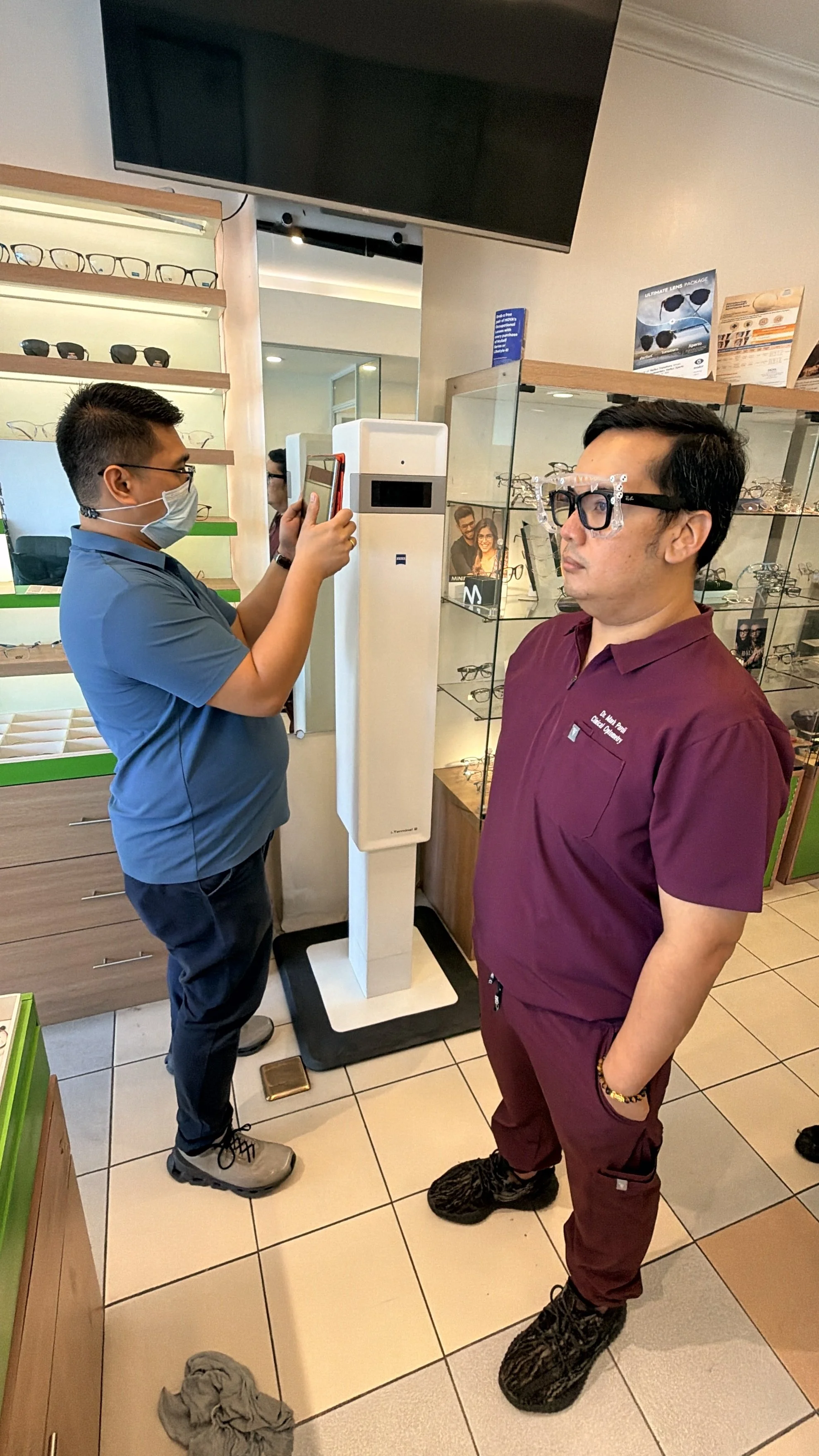
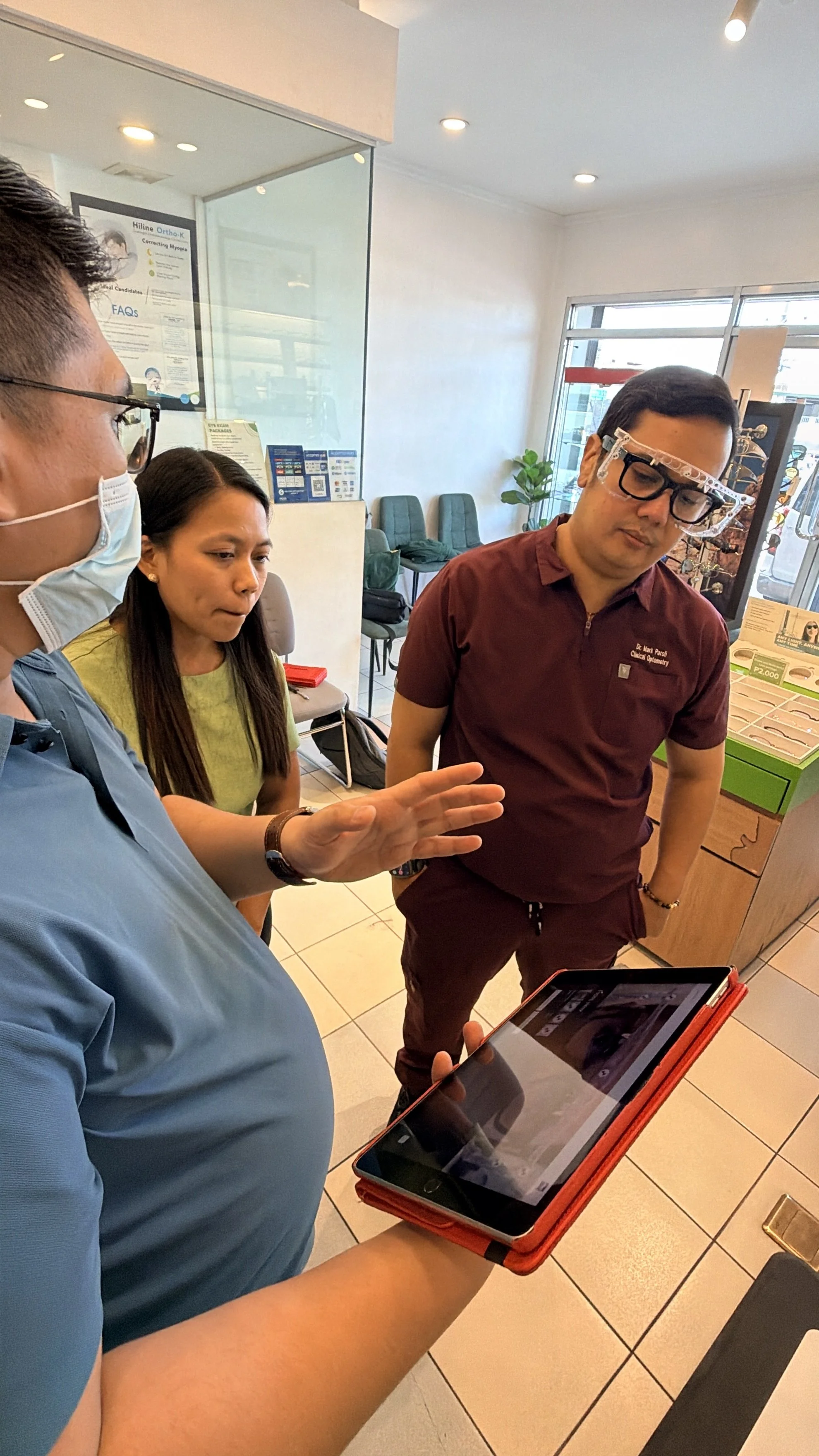
The Zeiss i.Terminal 2 being tested to be used for my new prescription.
You can't gather these hyper-accurate measurements with an old-school ruler or standard handheld device. Human error or tiny head tilts during manual measurements reduce precision.
That is where the Zeiss i.Terminal 2 comes in.
Step Up: You put on your new frames and stand in front of the device.
Snap: Using high-resolution camera technology, it takes a digital picture of your face and frames from multiple angles.
Analyze: The system instantly calculates your exact facial features, eye height, frame tilt, and curve with digital accuracy.
Send: This unique "data profile" is sent directly to the Zeiss optical lab.
Instead of stamping out a pre-made glass surface, advanced laser technology carves your prescription onto the back of the lens point-by-point, customized specifically for your face and frame choice.
Modern Life, Modern Lenses: Zeiss SmartLife Individual
In today's digital world, our eyes are constantly on the move. We glance down at a smartphone, look up at a computer, and check our surroundings hundreds of times an hour. Standard lenses are designed mainly for looking straight ahead, leaving the side edges blurry when your eyes dart around.
Zeiss SmartLife Individual lenses fix this problem by combining your i.Terminal 2 measurements with smart optical design:
Clear Peripheral Vision: It eliminates the blurry zones around the outer edges of the lens, giving you edge-to-edge sharpness.
Smooth Transitions: Your eyes move effortlessly between distance vision (like driving) and close-up vision (like scrolling on your phone).
Matches Your Habits: The optics are adjusted to match how you naturally move your head and eyes when looking at objects around you.
The Everyday Benefits You Will Feel
Upgrading to a tailored, premium lens isn't just about technical details—it directly changes how comfortably you see the world every day:
Immediate Comfort: Little to no "adjustment period" or dizziness when wearing new glasses.
No More Neck Strain: You don't have to tilt your head awkwardly to find the "sweet spot" in your glasses.
Richer, Sharper Colors: Fine-tuned optics improve contrast, making details pop and driving at night much easier on the eyes.
Less Eye Fatigue: Your brain and eye muscles don't have to work overtime to fight against tiny optical distortions, leaving your eyes feeling fresh at the end of a long workday.