

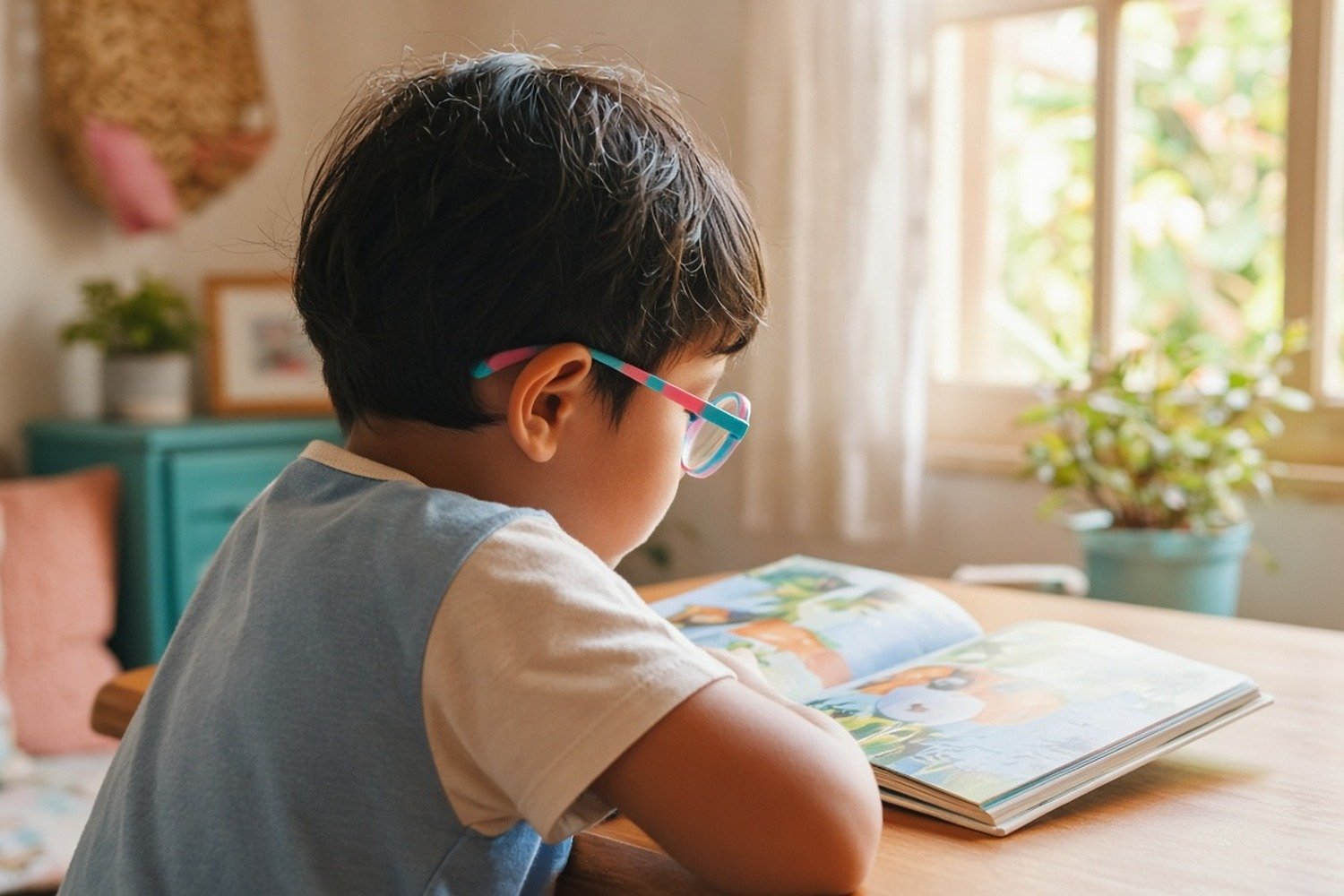
"Lazy eye" is a name many parents have heard. But here is the surprise: the eye isn't lazy at all, and it can look completely normal. Amblyopia is really about how the brain and the eye work together while a child's vision is still developing.
As an optometrist, I would love every parent to know a little about it, because it is easy to miss and it is best handled early.
What is amblyopia?
Amblyopia is a type of poor vision that usually affects one eye, and less commonly both. The brain and the eye don't work together properly, so the brain starts to rely on the stronger eye while vision in the weaker eye falls behind. The National Eye Institute (NEI) notes that people with amblyopia are not lazy and can't control how their eyes work.
It starts in childhood. The NEI describes it as the most common cause of vision loss in kids, affecting up to 3 out of 100 children.
What causes it?
Amblyopia is usually the result of another eye or vision problem. The three main types are:
| Type | What happens | Examples |
|---|---|---|
| Unequal blur (refractive) | One eye needs a much stronger prescription than the other, so the brain "turns off" the blurrier eye | Nearsightedness, farsightedness or astigmatism that is worse in one eye (anisometropia) |
| Strabismus | The eyes point in different directions, so the brain ignores the eye that is not lined up | One eye turns in, out, up or down |
| Something blocking vision (deprivation) | A cloudy or covered eye stops clear images from reaching the brain | A childhood cataract or a droopy eyelid (ptosis) |
The American Association for Pediatric Ophthalmology and Strabismus (AAPOS) says the unequal-blur type is the most common. It happens when a child needs glasses but doesn't get them early in life.
Why do kids rarely complain?
This is the part that worries me most. A child with amblyopia usually uses the stronger eye to get by, so nothing feels wrong to them. They have never seen any other way, and the weaker eye often looks perfectly normal. AAPOS notes that children don't usually complain about blurry vision, and that a problem is often found only with a vision test.
Some children may squint, close one eye or tilt their head. The NEI also lists poor depth perception as a possible sign. But many have no obvious signs at all. So "my child sees fine" is not a reliable test.
Why early checks matter
A child's vision develops in the first few years of life. The American Academy of Ophthalmology (AAO) explains that amblyopia should be found and treated as early as possible. The NEI recommends a vision screening at least once between ages 3 and 5. The American Optometric Association (AOA) recommends a comprehensive eye exam by 6 months and again at 3 years.
Screening matters because it can find amblyopia before a child (or you) would ever notice it.
How is amblyopia treated?
Treatment depends on the cause. In general, the first step is to correct the cause, and the second is to encourage the brain to use the weaker eye.
| Approach | How it helps |
|---|---|
| Glasses | Fix unequal blur and some eye-turning problems. For some children, glasses alone make a real difference (AAPOS) |
| Patching | A patch over the stronger eye makes the brain use the weaker one |
| Atropine eye drops | Drops in the stronger eye blur its vision for a while, which also pushes the brain to use the weaker eye. The NEI says that for some kids this works as well as patching |
| Treating the blockage | Surgery may be part of the plan for a cataract, droopy lid or strabismus. Patching or drops are often still needed before or after (AAPOS) |
AAPOS also mentions newer headset-based treatments in the US, which are still being studied.
Progress takes patience. Vision may start to improve within a few weeks, but it usually takes months for the best results, and some children need part-time treatment for a while afterwards to keep the gains (NEI, AAO). Your child's eye care professional will decide the right plan. Please don't start or stop treatment on your own.
Is it ever too late?
The earlier, the better. AAPOS says treatment works better in younger children. It also says NIH-supported studies found that starting treatment in younger teenagers, up to age 14, can still help vision, though not as much as starting younger. Amblyopia treatment is usually less effective in adults (NEI).
So if your child is already older, don't lose hope. A comprehensive eye exam is still worth doing, because some older children can still improve.
Frequently asked questions
Can a child outgrow lazy eye?
No. The AOA states that lazy eye will not go away on its own. AAPOS adds that untreated amblyopia in childhood can leave vision permanently blurry, even with the best glasses.
Will my child need to wear a patch all day?
Not necessarily. The NEI says some children wear a patch for about 2 hours a day, while others need it whenever they are awake. The right amount depends on your child, and your eye care professional will set it.
My child won't keep the patch on. What can I do?
This is very common. AAPOS and the AAO suggest distraction, rewards, and doing favorite activities such as coloring or tablet time while patching. Please tell your eye care professional if it is a struggle. Drops are sometimes an option.
Does amblyopia mean my child will be blind?
Amblyopia affects one eye most of the time, and AAPOS notes that when the other eye stays healthy, children can usually do most things in life without problems. That is why protecting the good eye matters. Most of the time, amblyopia caught early can be treated successfully.
Does a child's glasses grade tell me if they have amblyopia?
No, not by itself. Only an eye exam can tell whether a child has amblyopia and what is causing it.
A final word from me
If you have a young child, a vision screening or eye exam is one of the simplest things you can do, even when everything seems fine. Finding amblyopia early gives your child the best chance of seeing well.
👉 Want to know more? Follow Dr Mark Paroli for more family eye-health tips, or book an eye exam or consult to check your child's vision.
This article is for general information only and is not a diagnosis or a promise of results. Only an eye exam can tell if a child has amblyopia.
Sources
- American Academy of Ophthalmology, "Amblyopia: What Is Lazy Eye?": https://www.aao.org/eye-health/diseases/amblyopia-lazy-eye
- National Eye Institute, "Amblyopia (Lazy Eye)": https://www.nei.nih.gov/learn-about-eye-health/eye-conditions-and-diseases/amblyopia-lazy-eye
- American Association for Pediatric Ophthalmology and Strabismus, "Amblyopia": https://www.aapos.org/glossary/amblyopia
- American Optometric Association, "Amblyopia (lazy eye)": https://www.aoa.org/healthy-eyes/eye-and-vision-conditions/amblyopia